
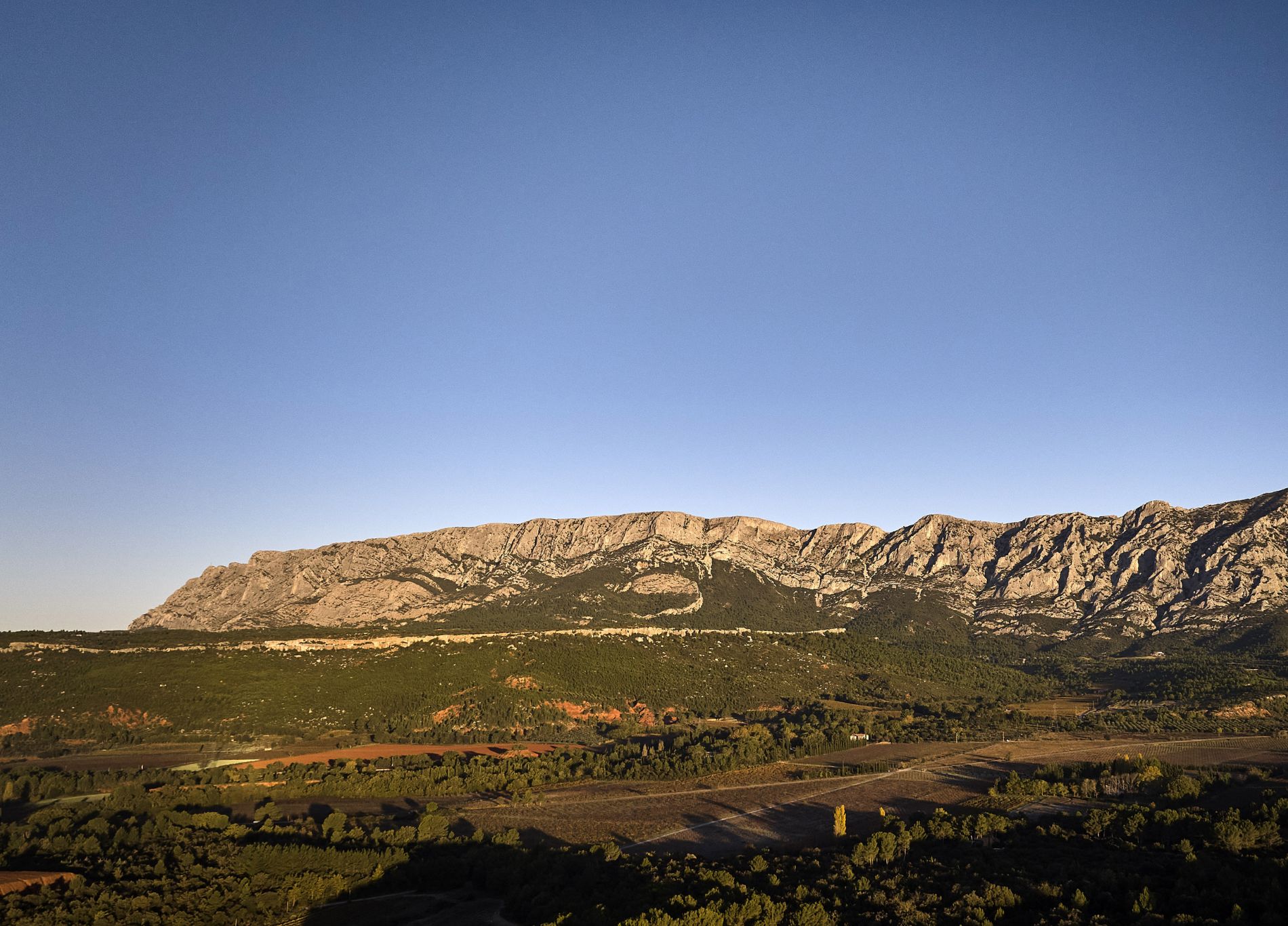
At the foot of the Sainte-Victoire mountain, Maison Gassier has always cultivated a certain vision of balance. A balance between power and freshness, between intergenerational expertise and respect for living systems. The recent recognition of Côtes-de-Provence Sainte-Victoire as the first Cru of the appellation highlights this uniqueness. But beyond the distinction, it brings responsibility: that of preserving the deep identity of this terroir in a context of climate change.
A natural balance to preserve
Sainte-Victoire benefits from a rare microclimate in Provence, particularly thanks to cooler summer nights that help preserve the wines’ aromatic freshness and natural balance. For Maison Gassier, this balance lies at the heart of its identity. Yet today, it faces new pressures: increasing drought, shifting vine cycles, and strain on resources. Producing outstanding wines can no longer be conceived without fully integrating these changes, nor without fundamentally rethinking agricultural practices.
This reflection is not new. As early as 2004, Maison Gassier undertook a structural transformation of its vineyard through an in-depth soil study. Each plot was carefully analyzed to adapt grape varieties and practices to the specific characteristics of the soils. This work led to a precise understanding of the estate, now structured into micro-plots, revealing the full diversity of Sainte-Victoire’s terroirs.
This foundational choice marked a turning point: the move toward precision viticulture, guided by living systems, where each decision aims to reinforce natural balance rather than constrain it.
Observe, understand, regenerate
For Maison Gassier, the transition goes beyond simple conversion. The shift to organic farming, achieved in 2016, is part of a broader approach, now seen as an obvious step rather than an end goal.
The challenge now lies elsewhere: in the ability to regenerate soils and strengthen vineyard resilience.
Maison Gassier is developing a comprehensive agroecological approach. The goal: to restore the soil’s primary function as a living ecosystem.
Several levers are being activated:
• reintroducing organic matter through local partnerships,
• planting cover crops to protect and nourish the soil,
• reducing inputs through collective initiatives among winegrowers,
• improving water infiltration to better cope with drought episodes.
Each vintage thus becomes a field for observation and adaptation: replanting differently, questioning monoculture, promoting biodiversity, and enhancing soil life.
Reintroducing biodiversity, restoring balance
In the face of climate change, preserving a terroir is no longer just about production—it is about restoring balance.
Maison Gassier fully embraces this approach by restoring ecosystems at the very heart of the vineyard: planting hedgerows, installing nesting boxes for protected species, and creating habitats favorable to local flora and fauna.
This approach goes beyond the vine itself. It considers the vineyard as a living landscape, where every element—soil, plants, insects, birds—contributes to the final expression of the wine.
With the creation of the Sentier des Vignes, open to the public, Maison Gassier shares this vision and raises awareness of the richness and fragility of this unique ecosystem.
A vision carried by a new generation
This transformation is part of a broader vision, driven by a generation fully aware of environmental challenges.
“We are a pivotal generation, between intensive and sustainable viticulture.” – Léa Rouyet
For Maison Gassier, this awareness translates into concrete choices: thinking in the long term, prioritizing quality over productivity, and accepting a degree of risk in order to better respect living systems.
The ambition goes beyond production alone: it is about passing on a sustainable vineyard, capable of enduring and continuing to express the full richness of Sainte-Victoire.
A Cru looking to the future
For Maison Gassier, the Sainte-Victoire Cru is not an end point, but a starting point. In the face of climate change, preserving a terroir now means allowing it to evolve.
Observe, adapt, innovate: these are the levers activated daily to maintain the freshness of the wines, preserve their identity, and meet the expectations of new generations.
Because at the foot of Sainte-Victoire, environmental commitment is not an option. It is an essential condition for ensuring that, tomorrow, the wines continue to faithfully tell the story of their origin.
“Preserving a terroir today means already committing to the terroir of tomorrow.”
– Léa Rouyet