
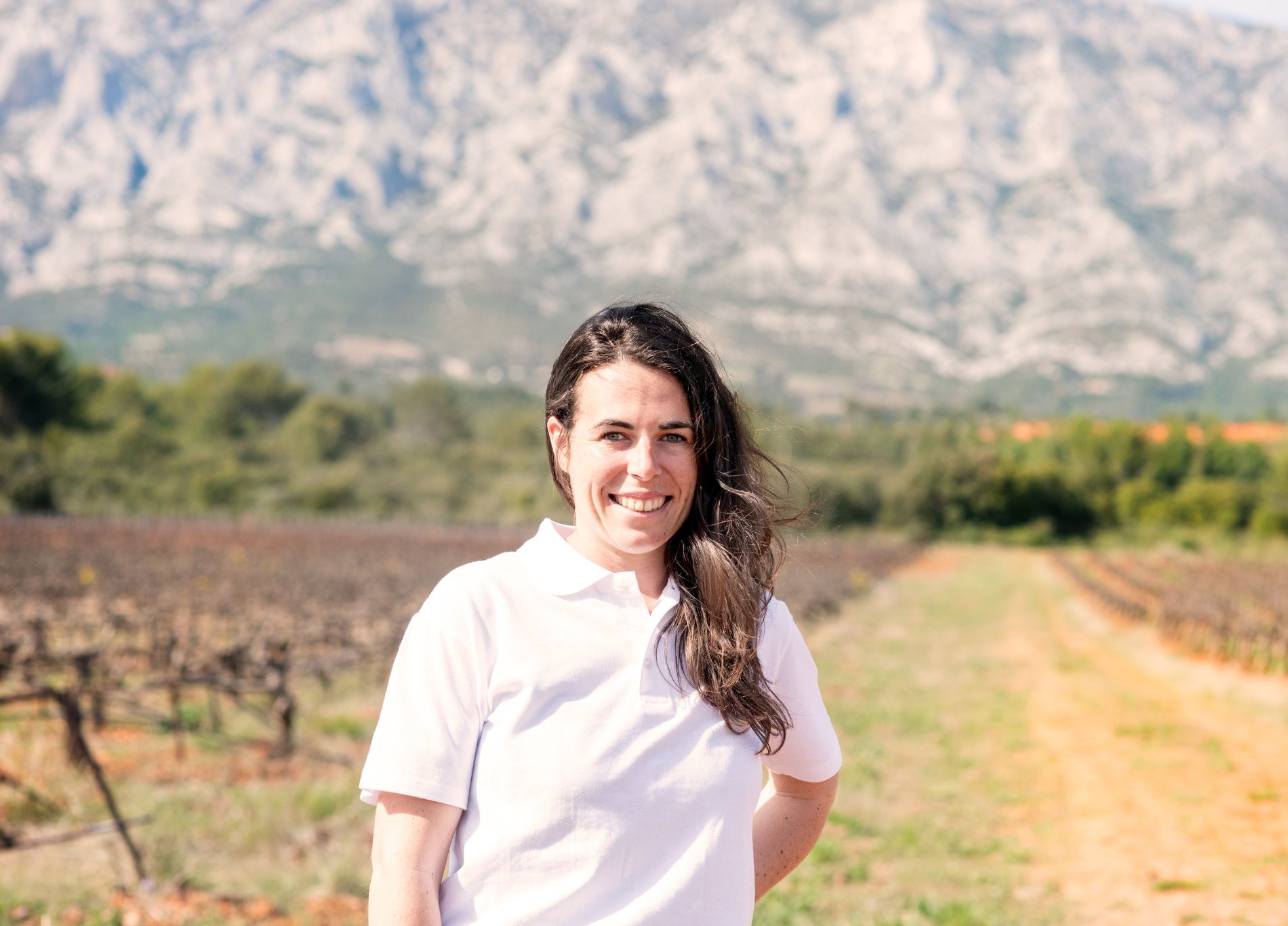
Léa Rouyet’s Journey at Maison Gassier, Cru Sainte-Victoire
On the occasion of International Women’s Rights Day, on March 8, we spoke with Léa Rouyet, oenologist at Maison Gassier. Located at the foot of the Sainte-Victoire mountain, Maison Gassier produces organic rosé and white wines under the Côtes de Provence and Côtes de Provence Cru Sainte-Victoire appellations.
Originally from the South-West of France, passionate about nature and committed to sustainable viticulture, Léa embodies a new generation of women in the wine sector: aware of environmental challenges, ambitious for gastronomic rosé wine, and deeply attached to terroir.
In this interview, she tells us about her journey, her vision of the oenologist’s profession and her commitment to a Provence wine that is both demanding, responsible and inspired.
Can you tell us about your background and how you came to Maison Gassier as an oenologist? What is your role today?
I am originally from the South-West of France, a region where gastronomy, good food and conviviality hold a central place. Since I was very young, I have been fascinated by family meals, moments shared around a good table, and naturally by the wine that accompanied them.
At first, I chose to study agronomy, attracted by the understanding of living systems, agriculture and natural cycles. During my studies in Perpignan, I discovered viticulture in a concrete and immersive way. Working on a small vineyard, following the growth of each vine, observing the influence of terroirs, and then seeing the grapes transform into wine immediately fascinated me. This comprehensive approach, combining cultivation, terroir and transformation sciences, perfectly matched my aspirations.
“The vine is a complete adventure: you start with soil and terroir, you cultivate, you observe, you transform… and at the end of the journey, you create a wine. This overall vision immediately appealed to me.”
After my technical degree, I continued my studies at an agricultural engineering school in Montpellier, specializing in viticulture. I then completed my final internship in the sustainability department of the Advini group. This experience allowed me to combine my passion for wine with my environmental commitment, with a focus on biodiversity and sustainability.
I then enriched my experience with a stay in New Zealand, to observe other viticultural practices. But it was in Provence that my journey truly took a turn: following my partner to the region allowed me to discover Maison Gassier and its exceptional vineyards at the foot of the Sainte-Victoire mountain. The environment, the quality of the terroir and the ambition of Maison Gassier for premium and gastronomic rosé wines convinced me to settle there permanently.
“The day I arrived in front of the Sainte-Victoire mountain, I felt immediate inspiration. Being surrounded by such a majestic landscape deeply influences our work and our creativity.”
Today, my role at Gassier is to oversee vinification, support vineyard management and ensure that each cuvée reflects our values of quality, pleasure and sustainable commitment, from the Gassier cuvée, through Le Pas du Moine-350, to the ageing wines 946 and ELEVAE.
A commitment to organic viticulture on the Sainte-Victoire terroir
You grew up surrounded by nature. How has this environment influenced the way you look at vines and wine today?
Absolutely. We are part of a pivotal generation, positioned between a more intensive viticulture inherited from the past and a thoughtful, sustainable and environmentally respectful viticulture. This directly influences my decisions on a daily basis.
At Gassier, we have implemented several practices: organic conversion of the vineyard, cover cropping between the rows to preserve biodiversity and soil freshness, limiting chemical treatments, soil regeneration and the use of fertilizers enriched with organic matter. Each decision is part of a long-term vision, because soil does not regenerate in a single year: the impact can be seen over several generations.
“When you work on the Sainte-Victoire terroir, surrounded by exceptional biodiversity, you cannot be satisfied with simply preserving it: we want to increase life, soil richness and vine health. Everything we do aims to leave a lasting legacy.”
These principles influence not only viticulture but also winemaking, the selection of grape varieties and the timing of the harvest. Every action, even the smallest one, which has its importance, is designed to minimize environmental impact and enhance the terroir.
Gastronomic rosé: a new vision of Provence wines
You joined Maison Gassier in 2015. What convinced you to commit to this project?
Beyond the exceptional setting of Sainte-Victoire, it was the philosophy of Maison Gassier that convinced me. The diversity of the ranges, from pleasure wines – Gassier & Le Pas du Moine-350 – to gastronomic rosé wines – 946 & ELEVAE – offers an immense field of creation. As an oenologist, this allows us to explore different techniques, evolve winemaking practices and adapt to each terroir.
“What attracted me at Gassier is this creative freedom: each cuvée has its own requirements, and each offers a unique tasting experience. It is a real playground for a passionate oenologist.”
Maison Gassier is also deeply rooted in its territory. Working here, on exceptional terroirs, with a project that combines pleasure, gastronomy, culture and sustainability perfectly matches my values.
Has your perspective on rosé evolved?
Yes, completely. Before arriving at Maison Gassier, I associated rosé with a summer wine, simple and convivial, the famous “pool rosé”. But at Gassier, I discovered that rosé could reach the same complexity and finesse as a great white or red wine, capable of accompanying a gastronomic menu.
“Rosé is not only a summer wine. It is a wine in its own right, capable of enhancing gastronomy. My first vintage of ELEVAE 2016 was a revelation: it showed that rosé could be ambitious, structured and elegant.”
This vision transformed the way I work, how I design blends and how I think about the potential of Provence vineyards.
Adapting an organic vineyard to climate change
In the face of climate changes, what decisions have profoundly modified the way you manage a vintage?
Climate change does not only impact one vintage: it transforms the way we think about viticulture in the long term. From the moment I arrived, we adjusted our practices : organic conversion, cover cropping, optimization of fertilizers and organic matter, soil protection, etc.
“Sustainable viticulture is not a one-time choice, it is a necessity. If we do not anticipate droughts, extreme heat and pressure on soils, it will be too late for our vines.”
It is a strategic reflection over decades, aimed at adapting the vineyard to new climate constraints while preserving the taste and identity of our wines.
If you wanted to leave a mark of your work at Gassier, what would you like people to say about you and your commitment within the estate?
That of a strong commitment to agroecology and sustainable development. I would like my time here to be associated with supporting and continuing the implementation of responsible practices that allow future generations to continue working in a living and preserved vineyard.
Do you think the role of an oenologist is to interpret a terroir or to reveal it without intervening more than necessary?
Terroir is already shaped by humans: the choice of soil, grape varieties and vineyard practices. My role is to accompany this expression while bringing my own touch. The objective is always to find the balance between authenticity and pleasure in tasting.
“We cannot let nature do everything 100%. Humans are part of the terroir. My work is to guide and reveal it, to create a wine that is both faithful to the terroir and enjoyable to share.”
The place of women in the wine world
How do you experience your place as a female oenologist today?
At the beginning, it was sometimes difficult: viticulture remains a traditional and very male-dominated environment. But I have seen things evolve over the past decade: more and more women hold positions in wine, whether in studies, internships or professional teams. The new generation is changing the landscape. Today, women are taking their place with competence and confidence, and are transforming a world that has long been very masculine.
What does International Women’s Rights Day represent for you?
It is a moment of reminder, to celebrate progress and reflect on what still remains to be accomplished. It is an opportunity to place women at the center of conversations and highlight their role in society and in the world of work.
“On the scale of history, women have only recently begun to take their place. This day reminds us of everything that has been done and everything that still remains to be done.”